Performance starts with formulation
Each industrial application imposes its own specifications for mechanical, thermal and chemical requirements.
Material selection and compound formulation are defined based on these criteria, ensuring compatibility, durability, and dimensional stability.
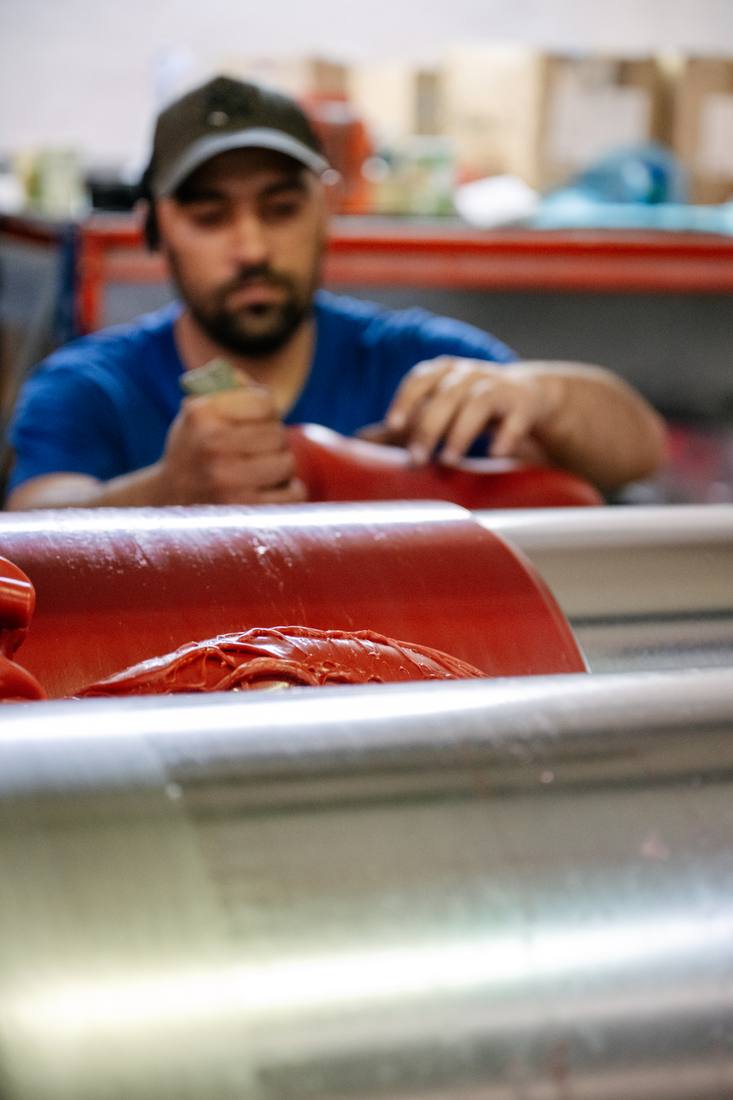
At Flexocol, rubber compounds can be mixed in-house or sourced from specialized compound manufacturers.
This flexibility allows us to match the origin of each compound to the stage of life of each product.
During the development phase — prototyping, samples, and small initial series — in-house mixing ensures fast response, direct control over formulation and raw materials, and the freedom to fine-tune the compound until validation.
When a product moves to repeat production and higher volumes, the validated formulation can be transferred to specialized suppliers, ensuring greater batch-to-batch consistency and better economic efficiency at scale.
Advantage of in-house compounding
Advantages of compounds purchased from specialized manufacturers
These are the types of materials Flexocol has experience working with.
The choice when maximum elasticity, resilience, and fatigue resistance are required. NR remains the reference for dynamic applications subject to repeated deformation.
✓ Outstanding mechanical performance, with high resistance to fatigue and crack growth
✓ Excellent electrical insulation properties
✓ High resilience — it returns most of the energy absorbed during deformation, minimizing heat build-up in dynamic service
✓ Good adhesion to metals.
⚠ - Limited resistance to oils, fuels, ozone, and weathering
The industry standard for applications in contact with oils, fuels, and hydraulic fluids. The first choice for seals, gaskets, and technical components.
✓ Excellent resistance to oils, greases, fuels, and hydraulic fluids
✓ Low gas permeability — well suited to gas sealing
✓ Good compression set, abrasion, and tensile resistance
⚠ Not suitable for strongly polar solvents (acetone, MEK), chlorinated or aromatic hydrocarbons, or sustained ozone and outdoor exposure.
⚠ Poor electrical insulation — behaves as a semiconductor, so unsuitable where insulation is required
Outstanding resistance to weathering, ozone, and temperature variation. The usual choice for components in permanent outdoor exposure.
✓ Exceptional resistance to ozone, UV, and weathering
✓ Excellent heat and oxidation resistance
✓ Good low-temperature flexibility, depending on ethylene content
✓ High-quality electrical insulation
✓ Good resistance to most inorganic chemicals — mineral acids, alcohols, detergents, and ketones
✓ Excellent hot water and steam resistance
⚠ No resistance to mineral oils, greases, fuels, or hydrocarbon solvents
The choice for the most demanding chemical and thermal environments. Often known by the trade name Viton®
✓ Excellent resistance to chemicals, oils, fuels, and lubricants
✓ Excellent high-temperature performance — continuous service up to around 200 °C
✓ Good mechanical properties
⚠ Reduced chemical resistance to alkalis and ketones
⚠ Limited low-temperature flexibility in standard grades
Thermal stability and flexibility across an exceptionally wide temperature range. Widely used in the pharmaceutical, food, aeronautical, marine, and automotive industries.
✓ Excellent high-temperature resistance — continuous service up to 220 °C
✓ Remains flexible at very low temperatures, down to around −60 °C
✓ Good resistance to ozone, weathering, and UV radiation
✓ Good electrical insulation
✓ Good fire behavior — low smoke, with non-conductive combustion residue (+ pending confirmation:
✓ Food- and pharmaceutical-grade formulations available (FDA))
⚠ Limited tear and abrasion resistance — less suited to demanding dynamic or abrasive duty
The choice wherever extreme wear resistance is required, often combined with oil and ozone resistance. Typical applications include damping elements, transmission components, diaphragms, wear parts, and roller coverings.
✓ Outstanding abrasion and wear resistance — among the highest of any elastomer
✓ High tensile and tear strength
✓ Remains elastic even at very high hardness — exceptional load-bearing capacity
✓ Good resistance to mineral oils, greases, and aliphatic solvents
✓ Good ozone, weathering, and aging resistance
✓ Good low-temperature flexibility
✓ Damping and rebound adjustable through formulation — from shock absorption to high resilience)
⚠ Limited heat resistance — continuous service up to 75–90 °C
⚠ Susceptible to hydrolysis in hot water and steam
Outstanding gas impermeability and high damping capacity.
✓ Very low permeability to gases and moisture — the lowest among common elastomers
✓ High vibration damping (high tan δ)
✓ Excellent resistance to polar solvents — ketones, esters, DMF
✓ Excellent steam resistance and good dry-heat behavior
✓ Good resistance to ozone and weathering
✓ Good resistance to animal and vegetable oils and fats
✓ Good low-temperature flexibility
✓ Good compression resistance
✓ Good electrical insulation
⚠ Low rebound at room temperature — slow elastic recovery, the flip side of its damping
⚠ Poor resistance to mineral oils, fuels, and hydrocarbon solvents
The balanced all-rounder: good resistance to weathering, ozone, aging, and a wide range of chemicals. Widely known by the trade name Neoprene®
✓ Good all-round resistance to weathering, ozone, and aging
✓ Good mechanical strength and abrasion resistance
✓ Good performance up to around 100 °C (short periods up to 120 °C)
✓ Moderate oil resistance — good with paraffinic oils, fair with naphthenic oils and aliphatic hydrocarbons
✓ Low gas permeability — well below NR or SBR, approaching NBR
✓ Inherently flame-retardant — self-extinguishing, does not propagate flame
✓ Flexible down to around −30 °C (special grades to −40 °C)
⚠ Reduced resistance to aromatic and chlorinated hydrocarbons and polar solvents
What role does the part play? Sealing, damping, transmission, wear protection?
What will it be in contact with? Oils, solvents, acids, hot water?
What temperatures will it face — continuous and peak?
What loads must it withstand? Forces, abrasion, repeated deformation?
Will it work outdoors? Direct sun, rain, ozone?
Are there regulatory requirements — industry or customer-specific? FDA, REACH, internal specifications?
The component's geometry and the selected material determine the most suitable production process.